
Description
Refrigerated Storage Containers – Reefers
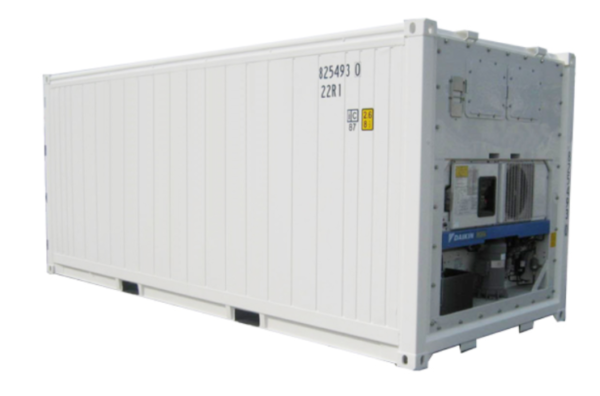
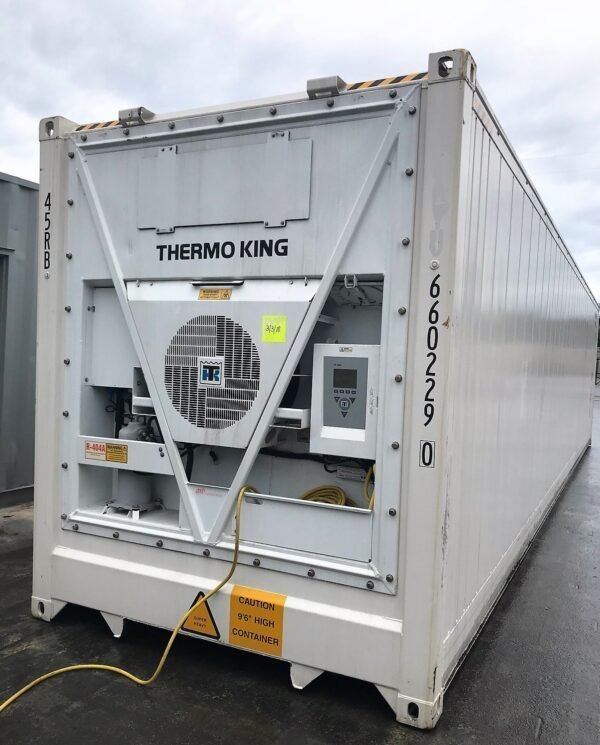
Refrigerated storage containers, commonly known as reefers, are temperature-controlled units designed for the storage and transport of goods requiring a stable, chilled, or frozen environment. They are actively cooled using an integral refrigeration system, making them distinct from insulated containers which lack a powered cooling unit .
Key Features
-
Active Temperature Control: Integrated refrigeration unit provides precise temperature management, typically ranging from -35°C to +30°C to accommodate a variety of products .
-
Superior Insulation: Walls, ceiling, and floor are fitted with high-performance insulation to minimize heat transfer and maintain internal temperatures efficiently .
-
Advanced Air Circulation: A T-bar flooring system and forced-air fans ensure cold air circulates uniformly around palletized cargo, preventing hotspots and maintaining product integrity .
-
Hygienic Interior: Interior is typically lined with stainless steel or food-grade aluminum, providing a durable, corrosion-resistant, and easy-to-clean surface .
-
Robust Construction: Built with a durable steel or aluminum outer shell to withstand the demands of transport and outdoor storage .
-
Data Logging: Features microprocessor-based controls for precise monitoring, data logging, and alarm functions .
Detailed Description
Reefer containers are constructed to be both wind and watertight, with a two-layered vacuumed wall structure that creates a highly effective thermal barrier . The heart of the system is the refrigeration unit, which operates on a three-phase electrical power supply. It uses a vapour-compression cycle to cool the air, which is then circulated through the container .
The primary purpose of a reefer is to provide a stable, predetermined environment for temperature-sensitive goods, protecting them from spoilage and degradation . They are widely used for both active shipping and as a cost-effective, versatile alternative to constructing permanent cold storage facilities on-site .
Technical Specifications
Specifications are representative for the majority of reefer containers and may vary.
20ft Refrigerated Container
-
Internal Dimensions (L x W x H): Approx. 5.44 m x 2.29 m x 2.27 m (17.9′ x 7.5′ x 7.5′)
-
Cubic Capacity: Approx. 28.3 m³ (999 ft³)
-
Approx. Tare Weight: 3,080 kg (6,791 lbs)
-
Max Gross Weight: Approx. 30,480 kg (67,196 lbs)
-
Door Opening (W x H): Approx. 2.23 m x 2.10 m (7.3′ x 6.9′)
40ft High Cube Refrigerated Container
-
Internal Dimensions (L x W x H): Approx. 11.58 m x 2.29 m x 2.50 m (38.0′ x 7.5′ x 7.9′)
-
Cubic Capacity: Approx. 67.3 m³ (2,380 ft³)
-
Approx. Tare Weight: 4,480 kg (9,880 lbs)
-
Max Gross Weight: 34,000 kg (74,960 lbs)
-
Door Opening (W x H): Approx. 2.29 m x 2.57 m (7.5′ x 8.4′)
Intended Use
Reefer containers are suited for a wide range of industries requiring temperature-controlled environments:
-
Food & Beverage: Storage and transport of produce, meat, seafood, dairy, frozen goods, and beverages .
-
Pharmaceuticals & Healthcare: Temperature-controlled storage for vaccines, insulin, blood/plasma products, and other sensitive biologics .
-
Chemicals & Industrial: Storage of materials and chemicals that are sensitive to temperature fluctuations .
-
Events & Catering: On-site cold storage for large-scale events and catering operations .
-
Logistics & Warehousing: A flexible alternative to permanent cold rooms for supply chain and distribution hubs .
Package Includes
-
Refrigerated shipping/storage container
-
Integral refrigeration unit
-
Digital temperature control panel
-
T-bar flooring for air circulation
-
Stainless steel or food-grade aluminum interior lining
-
Double cargo doors with locking hardware
-
Data logging and alarm system (varies by model)
-
CSC certification plate


Reviews
There are no reviews yet.